Workforce Intelligence
Keep ownership and deployment boundaries visible while integrating a broad multi-service prototype under hackathon constraints.
- 08:42
Morning shift synchronized
- 08:55
Attendance adjustment requested
- 09:10
Leave approval completed
Summarize three anomalies and link to source evidence before suggesting an action.
Context
A platform-shaped hackathon prototype
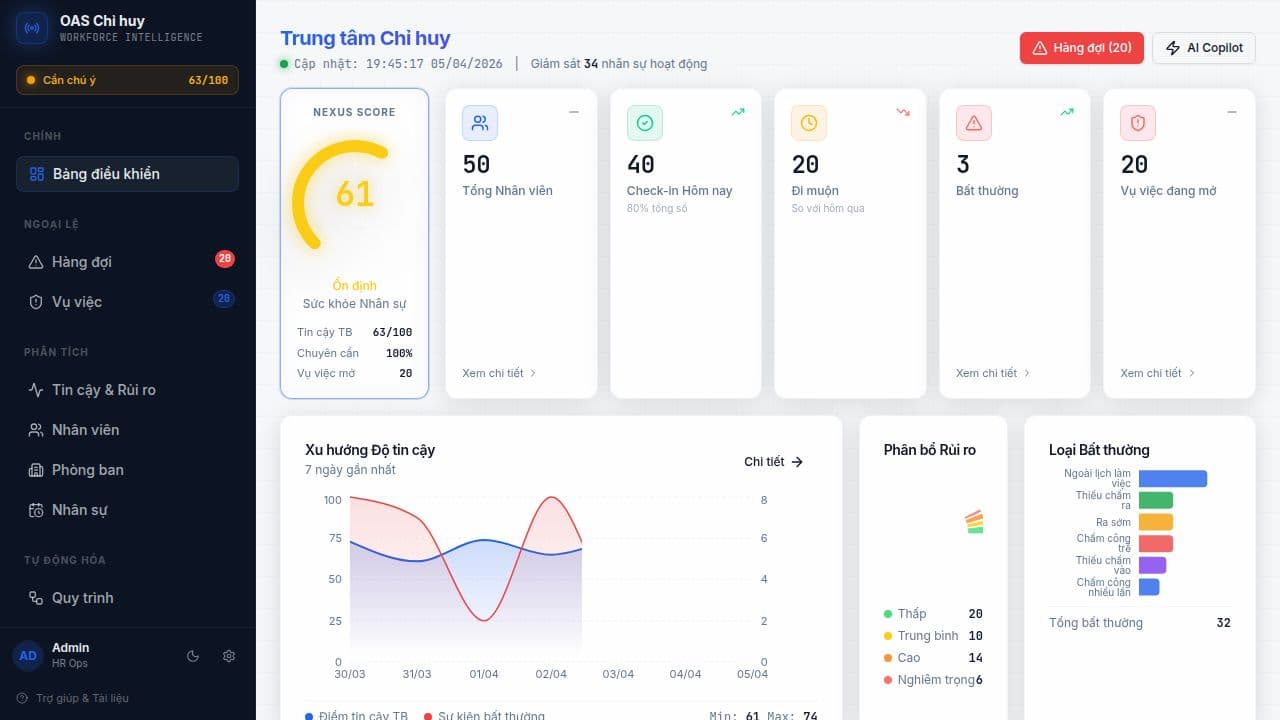
The project combines employee workflows, attendance and approvals, a command center, AI provider integrations, agent orchestration, browser signals, and face verification. The integration boundaries are the real engineering story.
Decisions
Keep service ownership visible
The repository preserves distinct responsibilities for workforce APIs, operations UI, AI and media integration, agent planning, and biometric services. That makes the prototype broader to operate, but easier to inspect and replace one subsystem at a time.
System
Integration with subsystem escape hatches
Service-level environment templates, startup paths, and verification commands allow a reviewer to evaluate one subsystem without requiring the complete demo topology. Optional providers and infrastructure remain explicit dependencies.
Evidence
Public implementation evidence
The public repository contains the implementation, service map, setup instructions, deployment notes, and the command-center artwork used in this portfolio. The official FPT Polytechnic event article provides independent team context.
Reflection
Breadth is both the demo and the debt
The broad service map made the prototype compelling, but it also raised setup and operational cost. The useful long-term artifact is the explicit boundary map, not a claim that every subsystem reached production maturity during a hackathon.
Result
Outcomes
- Published a service map and public-ready monorepo covering workforce, command-center, AI, browser-signal, and face-service components.
- Built most of the platform implementation within an approximately three-month hackathon delivery window.
- Added subsystem quick starts and verification commands so reviewers can inspect boundaries independently.
- Documented environment and deployment requirements instead of presenting the prototype as a one-click production platform.
Boundaries
Known limitations
- This is a hackathon prototype, not a production workforce system.
- Biometric, provider, and database workflows require environment-specific configuration.
- No attendance accuracy, fraud-prevention, or organizational impact metric is claimed.
Provenance
Evidence ledger
Public source
The monorepo exposes the service structure, setup guides, and implementation source.
Review sourceFPT Polytechnic Hackathon
The official event article identifies Nguyễn Thái Hảo as part of Penta Core.
Review sourceStack
Technologies
- ASP.NET Core
- React
- TypeScript
- Python
- Gemini
- Vertex AI
- SQL Server
- Redis
- Face recognition